

Children's learning thrives on exploration, questioning, and solving small puzzles independently. Simple games and activities that are "hands-on" can build their confidence and help young minds to develop logical thinking. The right types of activities also build problem-solving skills along with patience, creativity, and cooperation.
From puzzle games to pretend play scenarios, these games give kids a way to think out problems, recognize patterns, and hone in on crucial learning abilities.
Many parents and teachers are looking for the easiest way to build children's critical thinking without making it a demanding task for little ones. Luckily, a lot of what children do throughout the day is essentially a learning experience for them.
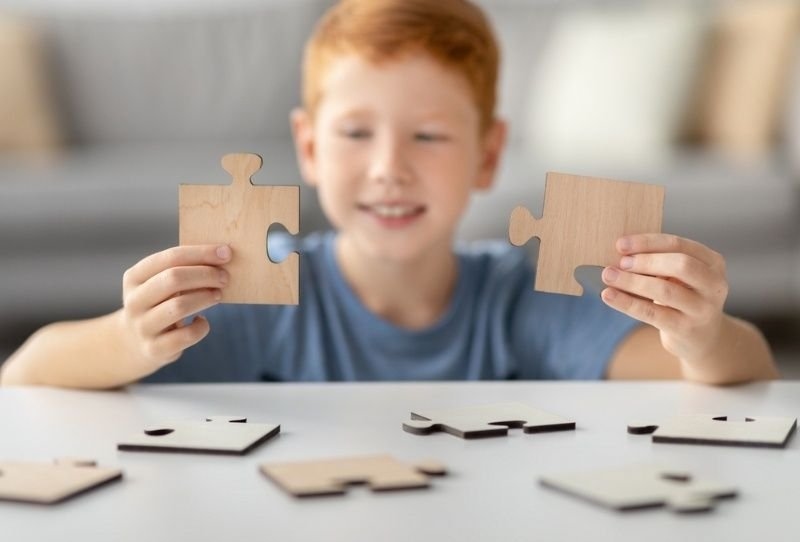
Perhaps one of the best activities to help kids with logical thinking is working puzzles. Jigsaw puzzles, shape sorters, and matching card games for kids all help build problem-solving and observation skills, along with the ability to think and concentrate patiently. The brain games for kids are known to boost memory and observation skills with repeated play over time.
Since young children are just beginning to understand shapes and patterns, it is best to start with larger puzzle pieces for your little ones. Harder puzzles can come later to build up their critical thinking skills even more when they have experience. The calm, silent environment of a classroom filled with puzzles is perfect to encourage preschool learning.
Shape-sorting games are perfect learning games for toddlers, as they introduce simple concepts in geometry and reasoning. Through play-based learning, children will be learning how specific shapes can fill space with their growing hand-eye coordination skills. Introducing shape blocks, or a play toy with shape cutouts, is a good way to keep games interesting for children.
These brain games for kids are also a chance to learn through trial and error. Through discovering what each shape will fit into by experimentation, kids can learn problem-solving in small ways.
When working with problem-solving activities, a set of memory cards is often an activity that children are interested in. The task is to flip cards over, remember the images, and find pairs to match. This boosts concentration skills and improves short-term memory as kids remember where each picture is on the card.
Add some animal, fruit, or favorite cartoon character pictures to the logical thinking games for children, and you will find an even higher engagement level with kids. They learn to concentrate with their memory tricks!
Playing with blocks and other construction toys is the ultimate toy that supports preschool cognitive development because they combine imagination and the need for critical thinking. Blocks, stacking cups, and magnetic building toys all promote understanding of balance, structure, and planning for children as they play.
While a child tries to build their play fort or castle, they might encounter problems like a tower falling over or not balancing. Kids learn to analyze the cause and try again, so building games fosters the critical thinking that children need.
Putting simple Lego building challenges together can make children's playtime more beneficial for their learning skills. Tasks such as "build a house for the toy elephant" or "build the tallest tower possible" get children to first envision their creation, think about the steps that they need to take, and learn spatial reasoning with Lego bricks or any other building block.
Playing with blocks is also an example of a good cooperative game. They will have to work with their friends to overcome any building problems that arise as they solve the game as a group.
When kids get a chance to take a step outdoors, it gives them an opportunity to put their brains to work along with their active bodies. A treasure hunt or obstacle course set up for them is a great learning game for toddlers that gets them to work out how to accomplish tasks that may include finding items in the shape of a certain figure or counting colored objects.
A walk in nature also helps encourage inquisitive minds to develop critical thinking in children. They can inquire why the leaves on the trees turn colors or ask how the ants built their home, and working through those questions together fosters an exciting and playful learning atmosphere for kids.
Pretend play is also excellent for preschool cognitive development because it develops imaginative and cognitive abilities while boosting problem-solving skills for children. Playing store, restaurant, or doctor encourages kids to put on a brave face and also play out how a person would act out the role.
While these games are not explicitly brain games for kids, they stimulate creative reasoning to solve any social or emotional problems that kids may come up against in their playtime world. When kids get a situation where they need to solve a small problem without an adult giving them the solution, their natural inclination will be to tap into problem-solving abilities and get their gears turning.
Another way to encourage language development, along with critical thinking, is to incorporate storytelling into their play. Start a story, and have them end it. They will have to think ahead in the narrative and be able to communicate their creative finishing thoughts through the story games.
These learning games for toddlers can also help develop their skills for paying attention. By listening to all the important parts of a story, they will learn to understand what happens first, next, and last to predict the outcomes of other events.
One of the most significant and powerful ways in which young children can foster their problem-solving skills is through play. Through playful activities, young children will learn to come up with answers, make decisions, and find solutions by themselves. Activities such as sorting games, matching games, building games, and role-play games teach children about problems in a fun and stress-free environment. There are so many effective motor skills activities you can implement to boost a preschooler's thinking.
A few minutes of dedicated playtime each day that includes problem-solving can have a huge impact on the cognitive development of your child. Kids just love to experiment, so if a problem solver seems a bit out of reach, just be sure it feels more like fun than homework.
Providing children with exciting and enjoyable activities will help build stronger thinking skills in every aspect. Small problem-solving activities help improve memory, communication, creativity, and the ability to make better choices. Puzzles, storytelling, and building challenges, as well as the others on this list, give children an excellent way to think outside the box and develop the critical thinking they will need later in life.
With a few simple and playful ways to involve kids in problem-solving, children will grow into more capable and independent thinkers over the years.
Brain games assist children with building their attention, memory, and logic skills. These games train children to recognize patterns, work through problems, and make independent choices. With regular brain exercises, children’s self-assurance also develops more rapidly, and their learning skills progress more quickly, as they are accustomed to tackling problems that life presents them with on a daily basis.
Logical thinking games enable young children to comprehend sequencing, pattern recognition, and cause-and-effect relationships, which help preschoolers with problem-solving and making decisions more calmly. Playing puzzles, sorting games, matching tasks, and similar educational activities improve their focus, patience, and learning abilities at a fun and lively pace.
Definitely, learning games for toddlers typically contain speaking, storytelling, and working together to some extent. By carrying out these actions, children get the opportunities to develop their communicative skills to put their thoughts in order and to actively listen to the speaker. By including role-play activities or games that allow cooperation, children enhance their vocabulary, confidence, and social aptitude as they are kept amused.
Youngsters do better with shorter periods of time as opposed to prolonged lessons with a very structured approach. Practicing fifteen to thirty minutes a day should be adequate for preschoolers. Regular learning helps build stable thinking habits without making children lose interest and get exasperated easily.
This content was created by AI